


Introduction – Income Tax Slab Rates
Every year when the Budget is announced, taxpayers wait eagerly to know one thing: “How much tax do I have to pay?” The answer lies in the Income Tax Slabs and Rates.
The slab system makes taxation progressive. This means people with lower incomes pay less (or no tax), and people with higher incomes pay more. Instead of charging a flat rate, the government divides your income into slabs and applies different rates to each portion.
This guide explains the income tax slabs in India for FY 2025-26, how to calculate your tax, and which regime (old vs new) might suit you.

What is an Income Tax Slab?
Think of your income as a ladder.
- The first few steps may be tax-free.
- As you climb higher, each step has a different tax rate.
- Only the portion of income within that step is taxed at that rate.
This ensures fairness: someone earning ₹4 lakh pays much less tax compared to someone earning ₹40 lakh.
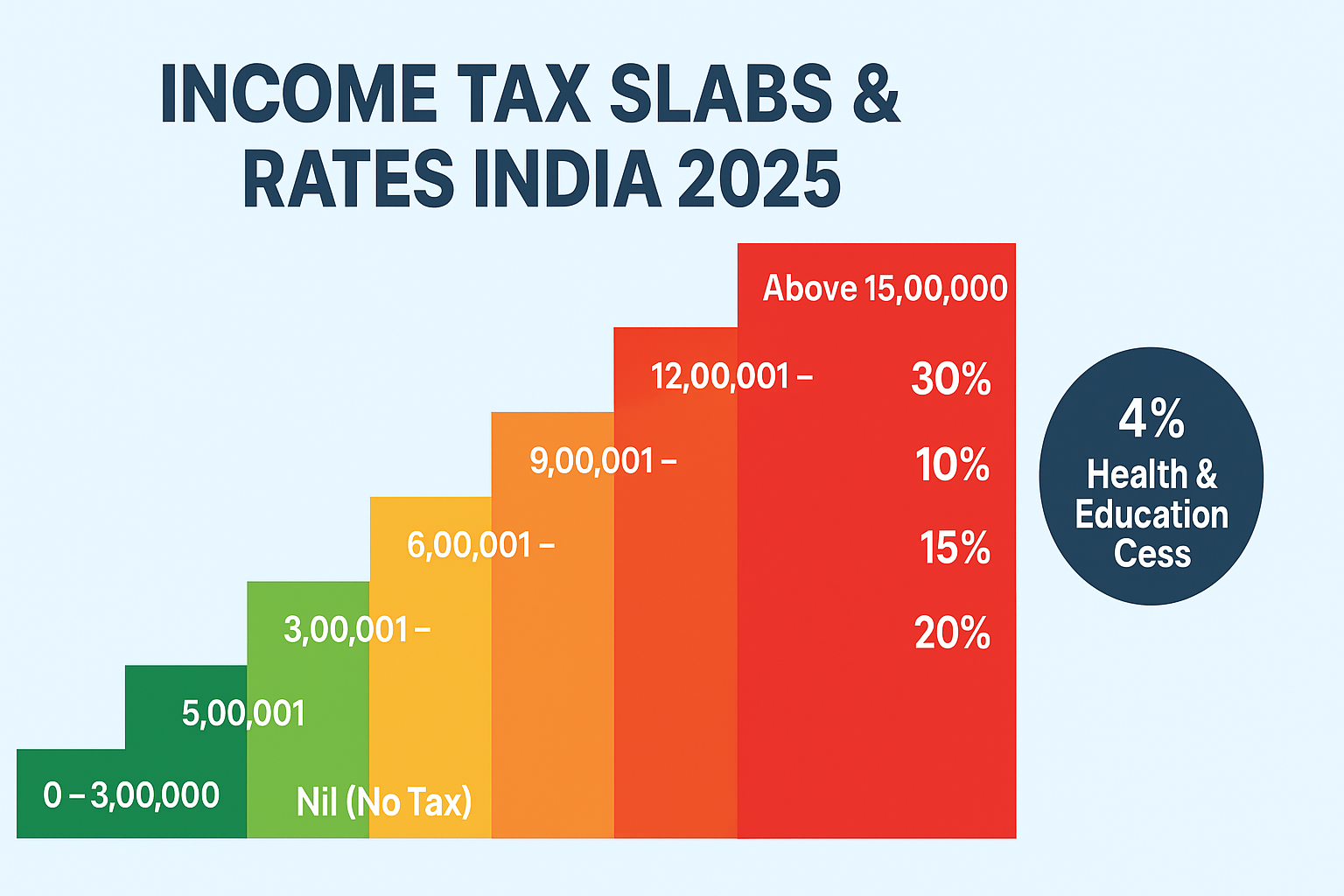
Income Tax Slabs for FY 2025-26 (New Regime – Default)
The new tax regime is now the default in India. It offers lower rates but fewer deductions/exemptions.
| Income Range (₹) | Tax Rate |
|---|---|
| 0 – 3,00,000 | Nil (No Tax) |
| 3,00,001 – 6,00,000 | 5% |
| 6,00,001 – 9,00,000 | 10% |
| 9,00,001 – 12,00,000 | 15% |
| 12,00,001 – 15,00,000 | 20% |
| Above 15,00,000 | 30% |
👉 On top of this, a 4% Health & Education Cess is charged on the total tax.
Old Regime vs New Regime
Taxpayers can choose between the old regime and the new regime every year (if they are salaried).
Old Regime
- Higher tax rates.
- But you can claim deductions and exemptions:
- 80C (LIC, PF, ELSS, tuition fees, etc.) up to ₹1.5 lakh.
- 80D (health insurance).
- HRA, LTA, housing loan interest, and more.
New Regime
- Lower tax rates.
- Very few deductions/exemptions allowed.
- But simpler to understand and calculate.
👉 Rule of Thumb:
- If you claim heavy deductions, old regime may save you more.
- If you don’t, the new regime is better.
Example Calculation
Let’s assume salary = ₹9,00,000 under the new regime.
- First ₹3,00,000 → No tax
- Next ₹3,00,000 (₹3L – ₹6L) → 5% = ₹15,000
- Next ₹3,00,000 (₹6L – ₹9L) → 10% = ₹30,000
Total Tax = ₹45,000
Add 4% cess = ₹46,800
👉 So, your tax payable = ₹46,800.
Now suppose your taxable income is ₹7,00,000 or less → you get Section 87A rebate. This means your entire tax is waived off. In short:
✅ Income up to ₹7 lakh → zero tax in the new regime.
Standard Deduction (For Salaried & Pensioners)
- A flat deduction of ₹75,000 is available in the new regime for salaried and pensioners.
- Example: If your salary is ₹8,00,000 → taxable income = ₹8,00,000 – ₹75,000 = ₹7,25,000.
- If your net income after this is ≤ ₹7,00,000, your tax = zero.
Surcharge (For High Incomes)
If you earn above ₹50 lakh, a surcharge applies:
| Income Level | Surcharge Rate |
|---|---|
| ₹50 lakh – 1 cr | 10% |
| ₹1 cr – 2 cr | 15% |
| ₹2 cr – 5 cr | 25% |
| Above ₹5 cr | 25% (reduced from 37%) |
Why Two Regimes?
The government introduced the new regime to simplify compliance and encourage voluntary filing. Many taxpayers found the old system too complex with its dozens of exemptions.
But since lakhs of people already planned finances around old regime benefits (like life insurance, PF, and housing loans), both regimes continue to exist side by side.
Practical Tips for Choosing Your Regime
- List your deductions/exemptions (LIC, PF, home loan interest, insurance, etc.).
- Calculate your tax under both regimes (many free calculators online).
- Choose whichever results in lower tax.
- Salaried taxpayers can switch every year; businesses cannot.
FAQs (Frequently Asked Questions)
Q1: Do I have to pay tax if my income is ₹4 lakh?
👉 Likely not, because of the standard deduction and rebate. Most salaried people at this level pay zero tax.
Q2: Which regime should I choose?
👉 Depends. If you have heavy deductions, old regime. If not, new regime is easier.
Q3: Do senior citizens get special benefits?
👉 Yes, under the old regime. Basic exemption is higher (₹3 lakh for 60–80 yrs, ₹5 lakh for 80+ yrs). In the new regime, the slabs are the same for all.
Q4: What if I don’t file my return?
👉 Penalty of ₹1,000 to ₹5,000. More importantly, it affects your financial record, loan eligibility, and compliance history. Always file.
TL;DR (Quick Recap)
- Income up to ₹3L → No tax.
- ₹3L – ₹15L → Taxed at 5% to 20%.
- Above ₹15L → 30%.
- Income up to ₹7L → Zero tax (rebate under 87A).
- Old regime = more deductions. New regime = lower rates, simple.
Conclusion
The income tax system may look complicated at first glance, but once you understand slabs, it becomes straightforward. The new regime is simpler and better for most people, while the old regime is still useful for those with big deductions.
Whichever you choose, remember:
- File your returns on time.
- Keep records of income and deductions.
- Review your tax planning every year after the Budget.
👉 Income tax is not just about paying the government—it’s about managing your money wisely.

Leave feedback about this